Speedway
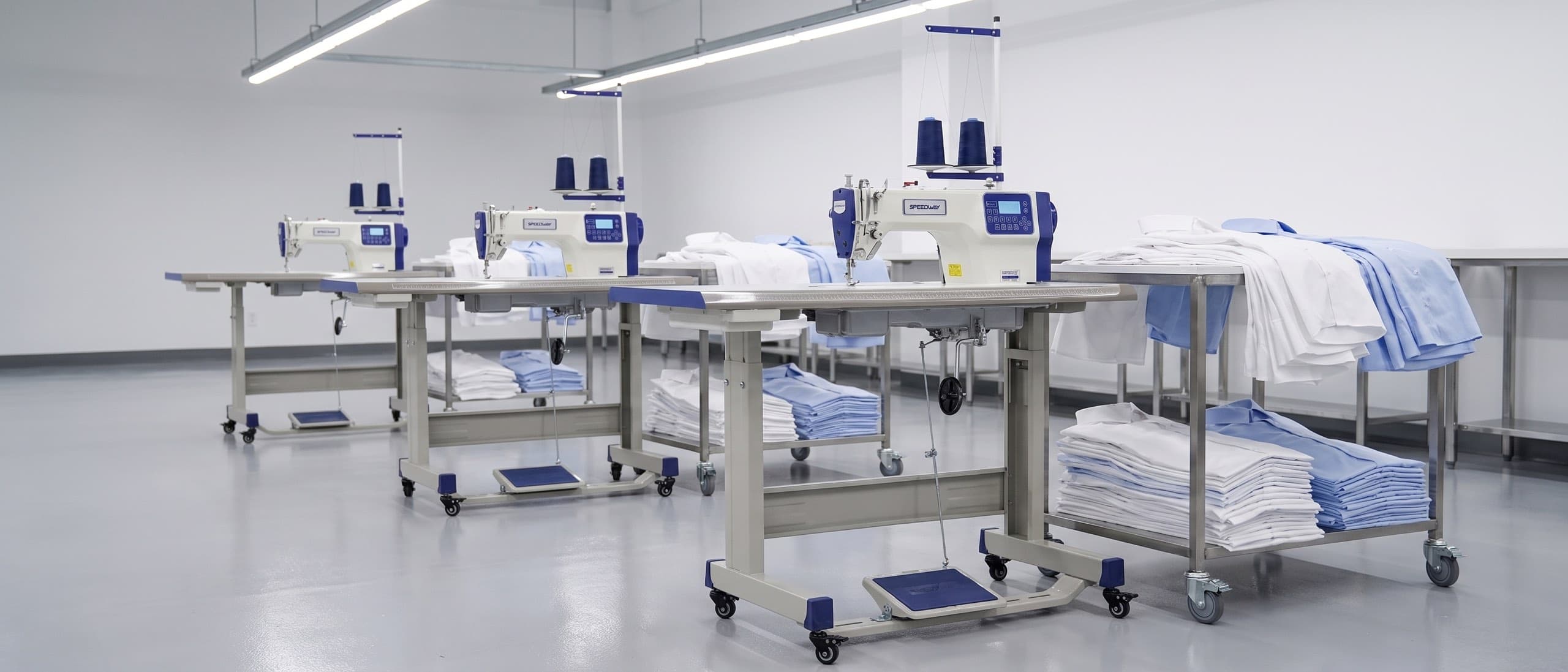
Apparel contract manufacturing line at end of shift — three industrial single-needle lockstitch machines along a long bench, stacks of cut denim panels on rolling carts, navy work apron at the back of the line

Use case · Apparel

Sewing apparel — knitwear, workwear, uniforms, denim.

Apparel production runs on a small set of machines doing repeatable jobs at volume. Lockstitch for the construction seams, overlock for the edge finishing, coverstitch for the hems, chainstitch for the specialty stretch, buttonhole and blindstitch for the finishing details. Speedway covers the whole set.

By Speedway Technical TeamPublished Updated

Key takeaways

  • A basic apparel line runs on a small repeatable set: single-needle drop-feed lockstitch for construction seams, a 4-thread overlock for edge finishing, and a coverstitch for knit hems.
  • Overlock seams panels and finishes the seam allowance in one pass; coverstitch is the only hem construction that survives a t-shirt bottom hem through 50 wash cycles without cracking.
  • Denim and workwear add specialty machines: 4-needle chainstitch for stretch waistband and coverall seams, plus digital and keyhole buttonhole machines for buttoned garments.

1. Construction seams

Single-needle drop-feed lockstitch is the apparel-line workhorse. The SW 8000 A handles 5,000+ SPM with stepper-motor auto functions — the kind of machine that runs ten years and rebuilds twice.

2. Edge finishing

Overlock — also called serger — finishes the seam allowance and seams the panels in one pass. Direct-drive 4-thread (SW 747 e) is the standard apparel construction overlock.

3. Knit hems

Coverstitch is the only construction that survives a t-shirt bottom hem through 50 wash cycles without cracking. Three-needle flatbed (SW 562/01CB) handles the standard configurations including activewear and athletic.

4. Specialty: chainstitch

Chainstitch (SP2000-4 4-needle) for jean waistbands and workwear-coverall seams that need elastic stretch.

5. Buttonholes

Every buttoned garment needs buttonholes. The SW 781 D digital buttonhole handles standard shirt-style straight buttonholes; SW-9820 covers keyhole/eyelet for jacket fronts.

Common questions

What machines do I need to set up a basic apparel line?
Apparel production runs on a small repeatable set: single-needle drop-feed lockstitch for the construction seams (the SW 8000 A workhorse), a 4-thread overlock for edge finishing and seaming the panels in one pass (SW 747 e), and a coverstitch for knit hems (the three-needle SW 562/01CB). Add a buttonhole machine for any buttoned garment, and chainstitch for stretch specialty seams.
What's the difference between overlock and coverstitch on an apparel line?
They do different jobs. Overlock — also called a serger — finishes the seam allowance and seams the panels together in one pass; direct-drive 4-thread is the standard apparel construction overlock. Coverstitch handles the knit hems: it's the only construction that survives a t-shirt bottom hem through 50 wash cycles without cracking, which is why three-needle flatbed coverstitch is used for activewear and athletic hems.
Which machines cover denim and workwear seams?
For jean waistbands and workwear-coverall seams that need elastic stretch, use the 4-needle chainstitch (SP2000-4). Buttoned workwear and shirts also need buttonholes — the SW 781 D digital buttonhole handles standard shirt-style straight buttonholes, and the SW-9820 covers keyhole/eyelet buttonholes for jacket fronts.